
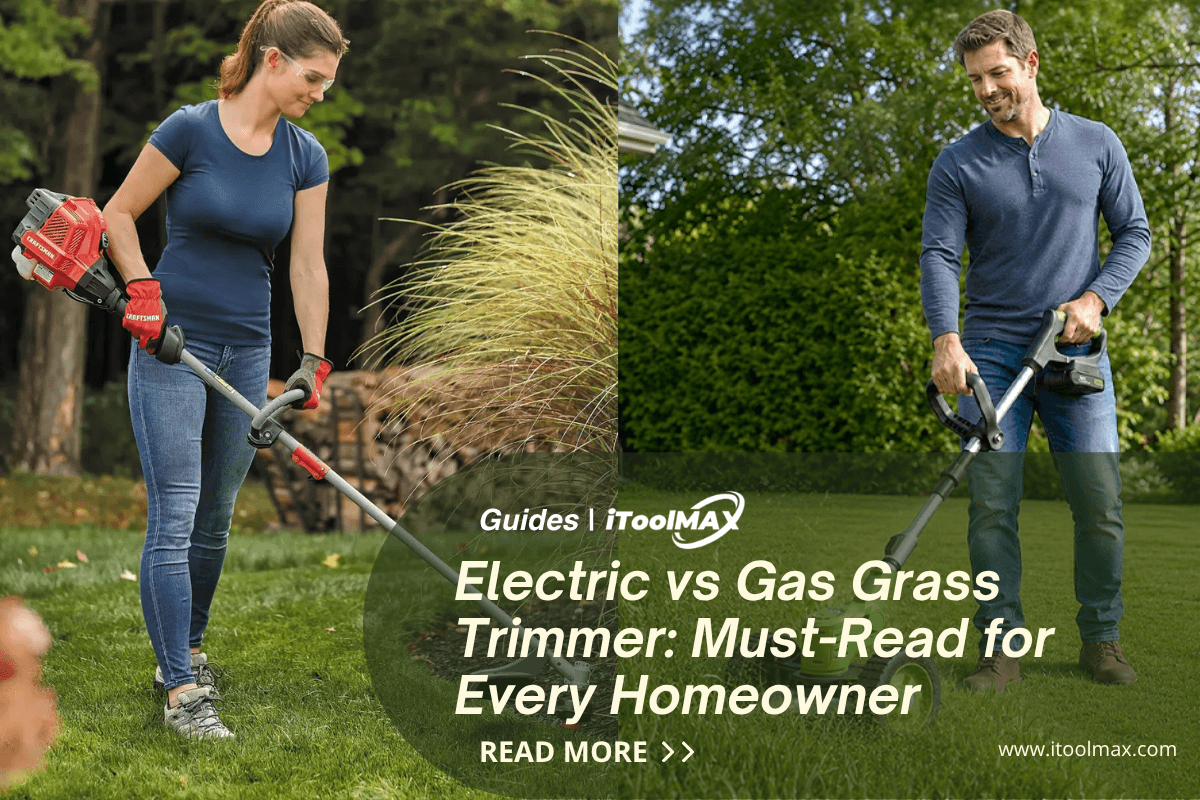
For most homeowners with a small or medium-size yard, a cordless electric grass trimmer is the better choice. It starts instantly, requires little routine maintenance, makes less noise, and is easier to carry. A gas trimmer still makes sense for long work sessions on large properties or frequent cutting through dense, woody growth.
The best choice depends less on the label and more on four questions: How much trimming do you actually do? What do you cut? How long must the tool run? How much weight, noise, and maintenance are you willing to accept?
By reading iToolMax comprehensive comparison guide, you’ll learn how to choose the right products for your yard and become a lawn mower expert—or at least half an expert.
What Are Electric and Gas Grass Trimmers?
Electric Grass Trimmer

An electric grass trimmer uses a motor powered by either a rechargeable battery or an extension cord. This guide focuses on cordless battery models because they give homeowners more freedom to move around fences, trees, driveways, and garden beds.
Cordless trimmers usually start with a button or trigger and require little routine motor maintenance. They are generally lighter, quieter, and easier to store than gas models. Their main limitation is runtime: the tool stops when the battery needs to be recharged or replaced with a charged spare.
Pros
- Fast, simple starting
- Generally lighter and easier to maneuver
- Lower noise and vibration
- No exhaust at the point of use
- Low routine motor maintenance
- No gasoline storage
- Good control for residential edging
Cons
- Runtime depends on battery, load, and conditions
- Charging requires time and access to power
- Extra batteries add cost and weight
- Entry-level models may slow in dense growth
- Batteries lose capacity with age and require proper recycling
Gas Grass Trimmer

A gas grass trimmer uses a small combustion engine and liquid fuel. It is commonly chosen for long sessions, remote properties, dense weeds, and repeated heavy cutting.
Gas models can be refueled quickly when approved fuel is available, but they are usually heavier, louder, and more demanding to maintain. Depending on the model, ownership may involve pull-cord starting, fuel preparation, air-filter care, spark-plug service, and seasonal storage procedures.
Pros
- Strong choice for sustained heavy cutting
- Fast refueling when more fuel is available
- Practical for remote properties
- Wide selection of heavy-duty and brush-cutting models
Cons
- Louder and usually more vibration
- Engine, fuel-system, and seasonal maintenance
- Exhaust at the point of use
- Fuel and oil expense
- Fuel storage and spill concerns
- Pull starting can be inconvenient
Electric vs Gas Grass Trimmer Quick Comparison
| Feature | Cordless electric trimmer | Gas trimmer |
| Cutting power | Strong enough for most routine residential work | Usually better for sustained heavy brush |
| Best fit | Small to medium yards; detail work | Large properties; repeated heavy clearing |
| Startup | Button or trigger | Usually a pull cord |
| Routine maintenance | Low | Higher |
| Noise and vibration | Generally lower(50–70 dB) | Generally higher(85 dB+) |
| Weight | Usually lighter(3-10lbs) | Usually heavier(16lbs+) |
| On-site exhaust | None | Yes |
| Operating cost | Electricity and eventual battery replacement | Fuel, oil, filters, plugs, and service |
| Precision work | Excellent | Good |
| Runtime | Limited by battery capacity and workload | Limited by fuel and operator refueling |
“Electric” in this guide means a cordless, battery-powered string trimmer. Corded models can work well close to an outlet, but the extension cord makes them less practical for larger yards.
#1 Choose Based on Your Yard Size: Electric or Gas Trimmer?
Yard acreage is a useful starting point, but the amount of trimming matters more than the total lot size. Use this table as a starting recommendation, then adjust for fence length, obstacles, slopes, vegetation density, and expected session time
| Yard size | Typical trimming work | Recommended trimmer | Why |
| Under 1/4 acre | Townhouse yard, front lawn, sidewalks, flower beds, and short fence lines | Cordless electric | One battery may be enough; the tool is easy to start, carry, store, and maneuver |
| 1/4 to 1 acre | Typical suburban yard, several garden areas, driveway edges, trees, and longer fences | High-output cordless electric, preferably with a spare battery | Strong residential performance with less noise, vibration, and routine maintenance |
| More than 1 acre with limited edge work | A mower handles the open lawn; trimming is limited to trees, buildings, borders, and sidewalks | Cordless electric | Lot size is large, but the actual trimming session may still be short |
| More than 1 acre with long or heavy trimming | Remote fence lines, dense weeds, overgrown areas, and extended sessions | Gas or professional battery system | Better suited to sustained work when refueling or multiple charged batteries are available |
Conclusion: Choose cordless electric for most small and medium residential yards. It is also a smart choice on large properties when a mower handles the open areas and the trimmer is used only for finishing work. Choose gas—or a professional battery platform with enough spare batteries—when dense growth, remote locations, or long duty cycles regularly exceed a homeowner battery system’s practical runtime.
#2 Noise Comparison: Electric vs Gas Grass Trimmer
Winner: cordless electric
Electric tools offer distinct advantages when working in noise-sensitive residential areas. **Battery-powered trimmers eliminate the noise of internal combustion engines and typically produce less vibration; measurements show noise levels fluctuating between 50 and 70 decibels, although the cutting line and clippings still generate some sound. It is still recommended to wear hearing protection.
A quiet grass trimmer is particularly useful for:
- Smaller lots where neighbors are close
- Residential communities with permitted work hours
- Early-day maintenance
- Longer sessions where vibration contributes to fatigue
Gas trimmers add engine noise and vibration to the sound of the cutting head. The EPA advises buyers to consider electric and battery-powered lawn equipment because it is quieter and pollutes less than gasoline equipment ([U.S. EPA].
#3 Precision Work: Which Trimmer Performs Better?
|| Lawn Edging and Trimming Around Obstacles
Winner: cordless electric
For sidewalks, flower beds, fences, trees, and other detailed areas, a lighter, well-balanced cordless trimmer is easier to start, stop, and reposition. Variable speed can improve control near delicate plants and hard surfaces.
What’s the best electric weed eater for edging?
The best electric weed eater for edging is a lightweight, well-balanced model with an adjustable cutting head, clear sightline, edge guide or support wheel, and precise speed control. A convertible trimmer-edger such as the iToolMax 3-in-1 cordless grass trimmer may suit homeowners who want one cordless tool for lawn edges and routine trimming, provided its approved attachment and guard match the task.
|| Cutting Small Branches and Tough Weeds
Winner: Depending on the cutting system, cordless grass trimmers generally come equipped with the matching blades.
When performing an initial trim in dense vegetation, a gas-powered model is usually the best choice. However, for routine maintenance, most cordless lawn mowers come equipped with metal circular saw blades, allowing you to trim small tree branches, shrubs, and the like in your yard.
#4 Ergonomics and User Comfort Comparison
Winner: cordless electric
| Cordless Electric Trimmer | Gas Trimmer | |
| Weight | 3-10lbs | 16lbs+ |
| Vibration | Minor | Intense |
| Height Adjustment | ✔ | ✘ |
| Adjusting the Mower Head | ✔ | ✔ |
| Adjusting the Handle | ✔ | ✘ |
| Side Wheels | ✔ | ✘ |
Cordless models typically offer more customizable features, such as blade replacement and height adjustment, to protect the user’s shoulders and back. As a result, they are well-suited for women and older users, as well as those switching from gas-powered to electric lawn mowers for the first time.
Final Verdict
For most U.S. homeowners, electric wins. Modern cordless trimmers provide enough capability for routine grass, lawn edges, fence lines, and garden cleanup while reducing noise, starting effort, and routine maintenance.
Choose gas when the work—not merely the lot size—requires long sessions in thick vegetation, remote refueling, or a heavy-duty cutting system. If your open lawn is handled by a mower and your remaining work is mostly detail trimming, cordless may still be the better tool on a large property.
| If you… | Choose |
| Maintain a small or medium backyard | Cordless Electric |
| Want quieter operation | Cordless Electric |
| Prefer minimal routine maintenance | Cordless Electric |
| Trim mainly around gardens and fences | Cordless Electric |
| Work far from charging for long periods | Gas |
| Clear dense vegetation regularly | Gas or professional battery |
| Need repeated all-day duty cycles | Gas or professional battery |
If you’d like to learn more about electric or gas-powered lawn mowers, feel free to contact us anytime (support@itoolmax.com). We offer free shipping and a one-year warranty.
Best Cordless Grass Trimmer for Homeowners—3-IN-1 Cordless Grass Trimmer

For homeowners who want one lightweight cordless tool for routine trimming, edging, and small-yard cleanup, the iToolMax 3-in-1 model is worth considering. The current product page lists:
- Trimmer, edger, and mower-style functions
- A listed weight of 3.26 pounds
- An adjustable shaft and cutting-head angle
- Two included 21V, 2,000 mAh batteries
- A listed charging time of two to three hours
- Plastic, stainless-steel, and circular-blade accessories
- A safety lock that must be used with the power button
⛓️💥 3 In 1 Cordless Grass Trimmer, Weed Eater and Edger
Those features make the model most relevant to homeowners who prioritize low tool weight, adjustable reach, and easy switching between common garden tasks. Two batteries can also reduce interruptions, although actual runtime depends on the attachment, vegetation, speed, temperature, and operator technique.
FAQ
What is the best grass trimmer for home use?
For most homeowners, the best grass trimmer is a lightweight cordless electric model with a brushless motor, adjustable shaft, variable speed, and enough battery capacity to finish one normal session. Choose a cutting width and complete operating weight that fit your yard; gas is usually necessary only for long, remote, or consistently heavy clearing.
Are electric weed eaters powerful enough?
Yes. A quality cordless weed eater is powerful enough for routine residential grass, lawn edges, and many common weeds. Dense woody growth, wet vines, and long commercial sessions may require a high-output brush cutter, gas model, or professional battery system.
Are battery string trimmers as good as gas?
Yes, battery string trimmers can be as good as gas for routine residential trimming, edging, tall grass, and common weeds. Gas still has an advantage when you need fast refueling for extended remote work or regularly cut dense, woody vegetation. Compare the complete tool, battery system, runtime conditions, and approved cutting attachments rather than power source alone.
What’s the best electric weed eater for thick grass?
The best electric weed eater for thick grass is a high-output brushless model with variable speed, a wide cutting swath, an appropriate heavy-duty line, and a high-capacity battery or spare battery. For woody stems or tangled brush, use only a manufacturer-approved brush-cutting attachment—or choose a purpose-built brush cutter—instead of forcing standard trimmer line through the material.
What is the best trimmer for a large yard?
Choose according to trimming time and vegetation, not acreage alone. A cordless trimmer can maintain edges on a large mowed lot, while long fence lines and dense growth may justify gas or a professional battery platform with spare batteries.
Can an electric trimmer cut small branches?
Standard trimmer line should not be used to cut branches. Use only a manufacturer-approved blade on a tool designed for brush cutting, or use a purpose-built pruning tool. Follow the manual for guards, handles, and protective equipment.
Most users read:
Teilen:
Die 8 besten Gartengeräte gegen Rückenschmerzen im Jahr 2026
When to Decorate for Halloween? The Perfect Decor Timeline