
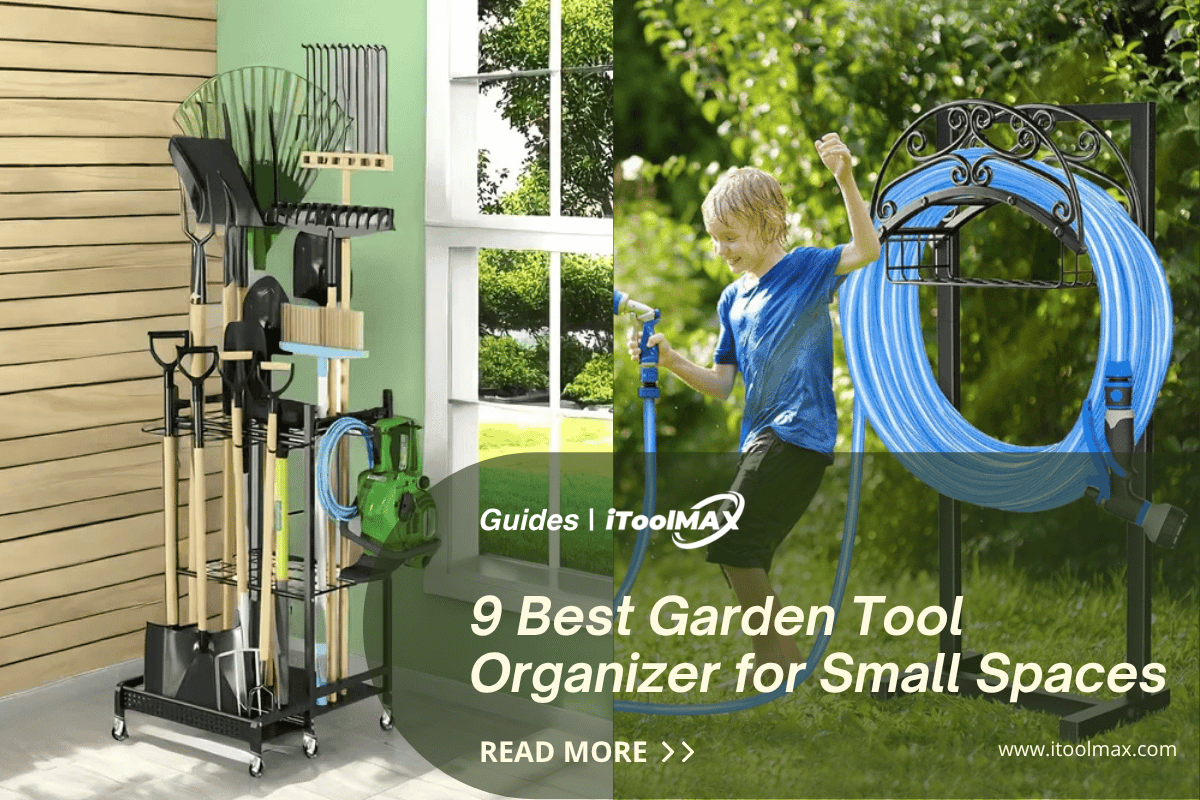
I once got my foot hit by a rake while opening the garage door, so I know this all too well. Gardening tools are inherently difficult to store—long handles, sharp edges, rechargeable batteries, and hoses that get tangled into a hopeless knot if you’re not careful.
The good news is: you don’t need to expand your living space to solve this problem. What you need is the right gardening tool storage solution. iToolMax will explain in detail why proper storage is crucial, what to look for before buying, nine practical storage products worth considering, and how to organize everything from hand trowels to cordless hedge trimmers—so your small space finally works for you, rather than against you.
Here's what you'll learn:
- Nine specific garden tool organizer ideas, with pros, cons, and space requirements
- How to store long-handle tools, hand tools, and cordless power tools differently
- A seasonal checklist to keep everything running for years, not months
9 Best Garden Tool Organizer Ideas for Small Spaces
1. Freestanding Garden Hose Holder with Storage Basket

A coiled garden hose holder left in a heap on the patio is one of the most common small-space clutter culprits — and it kinks the hose besides. This freestanding holder uses a reinforced base with four ground anchors to hold up to 150 ft of hose on an arched frame, plus a built-in basket for nozzles, gloves, and connectors. No drilling is required — it's simply staked into the ground and can be repositioned anywhere in the yard.
- Best for: Patios, lawns, and garden beds where you want hose storage without mounting anything to a wall.
- Pros: No-drill setup; holds a genuinely large hose length; basket keeps small accessories with the hose instead of scattered around the yard.
- Cons: A few owners reported light surface rust at weld points after rain, so a rust-inhibiting touch-up coat is worth doing on day one; works best on firmer ground rather than very soft soil.
- Space required: About 15.5 in. wide by 43 in. tall — a small footprint for the amount of hose it clears off the ground.
2. Garden Tool Organizer on Wheels with 8 Hooks

This is the closest thing to a dedicated answer to "how do I organize garden tools in a small garage." It's a rolling steel rack with 35+ tool slots plus eight adjustable hooks, rated to hold up to 75 lbs, and it snaps together without tools in under five minutes.
- Best for: Garages and sheds with limited wall space where tools need to come off the floor without a permanent installation.
- Pros: Mobile — roll it to wherever the job is, then roll it back; holds long-handled tools like rakes and shovels alongside smaller D-handle tools; powder-coated steel resists rust.
- Cons: Some buyers found the footprint smaller than the photos suggested, so measure your tool collection against the 19.6 in. shelf depth before assuming it'll hold everything.
- Space required: 29.5 in. tall, roughly the footprint of a small bookshelf — minimal floor space for a high tool count.
3. 8-Outlet Power Tool Organizer Wall Mount

Cordless tools create a storage problem hand tools don't: batteries that need to charge somewhere safe. This wall-mounted unit combines three tiered shelves, four side hooks, and an integrated 8-outlet power strip, so drills, trimmer batteries, and chargers can sit and charge in one place instead of sprawled across a workbench.
- Best for: Anyone with multiple cordless tools (drills, trimmers, sanders) who's tired of hunting for chargers.
- Pros: Each shelf holds up to 33 lbs; the built-in power strip eliminates extension-cord spaghetti; assembles in about five minutes.
- Cons: Mounting to masonry or a metal cabinet (rather than drywall over studs) may require extra drilling effort, as one reviewer noted when mounting to a steel server rack.
- Space required: Compact at 8.9 in. deep × 12 in. wide × 16.5 in. tall — fits in tight wall sections between studs.
4. Wall Mounted Steel Storage Rack

For long-handle tools, lumber, ladders, or anything else that's awkward to hang on a hook, this heavy-duty steel rack folds flat against the wall and supports up to 460 lbs per two-bracket set (or 920 lbs with the four-bracket option).
- Best for: Garages and workshops storing ladders, long-handle tools, or lumber overhead and off the floor.
- Pros: Genuinely heavy-duty weight rating; folds flat in seconds when not in use, which matters in a small garage where every inch counts; ventilated, off-ground storage keeps tools dry.
- Cons: Requires proper wall-stud installation given the weight it's rated for — this isn't a no-drill product.
- Space required: About 14.6 in. × 17.3 in. per bracket pair, but the real space savings come from what it gets off the floor.
5. 2-in-1 Solar Light Planter Pot

This one isn't a tool organizer in the traditional sense — it's a planter with a built-in solar light. We're including it because decluttering a small patio isn't only about racks and hooks; it's also about reducing the number of separate objects competing for the same few square feet. A 2-in-1 planter-and-light combo means you don't need a separate decorative light fixture and a separate plant stand cluttering your storage area.
- Best for: Lighting a patio storage or work area at night without adding another standalone fixture to a small space.
- Pros: No wiring; auto on/off at dusk; doubles as a planter so it earns its spot instead of just taking one up.
- Cons: It's a decor item, not dedicated tool storage — don't expect it to solve clutter on its own; the housing is plastic, so it's not as rugged as the steel options on this list.
- Space required: Minimal — about 28.5 in. × 11 in. × 11 in., similar to a standard planter.
6. 11-Pcs Aluminum Alloy Garden Tool Set

Sometimes the best "organizer" for hand tools is simply a kit that already includes a bag. This 11-piece set bundles a trowel, hand rake, cultivator, weeder, pruning shears, and more into a single Oxford-cloth tote — which means your most-used hand tools live in one grab-and-go bag instead of rattling around loose in a drawer or bucket.
- Best for: Anyone replacing a mismatched pile of loose hand tools with one consolidated, portable set.
- Pros: The included tote keeps everything together; lightweight aluminum construction resists rust; works well alongside a wall rack or wheeled organizer as the "hand tool" component.
- Cons: It's a tool set first and an organizer second — pair it with one of the wall or wheeled racks above if you need true wall storage too.
- Space required: Fits in a single tote bag — easily tucked onto a shelf or hook.
7. Garden Cart Seat with 360° Universal Wheels

This rolling garden seat earns a spot on a storage list because of what's built into it: a 12 in. × 8 in. tray plus a back tool pouch, so pruners, gloves, a trowel, and seed packets travel with you instead of getting left behind on a bench. The seat itself swivels 360°, rides on all-terrain wheels, and supports up to 330 lbs, folding flat for storage when you're done.
- Best for: Small yards and raised-bed gardening, especially for anyone who wants tool storage and a comfortable, mobile seat in one unit.
- Pros: Genuinely useful dual storage (tray + pouch); folds to about 5 in. thick for storage between uses; height-adjustable from 12.6–16.1 in.
- Cons: No wheel locks/brakes, so it's not ideal on a slope; a few reviewers found the seat sits closer to the ground than expected.
- Space required: Folds flat for storage; unfolded footprint is similar to a small stool on wheels.
8. Adjustable Door Hanger (No-Drill Hanging Bracket)

Marketed as a Christmas garland hanger, this adjustable, bendable steel bracket is worth a second look for tool storage in rentals, sheds, or anywhere drilling isn't an option. It clamps onto doors from 32 in. to 81 in. wide with anti-slip pads, holds up to 66 lbs, and leaves zero marks when removed — which makes it a legitimate no-drill way to hang lightweight tools, a coiled hose, or a tote bag from a shed door or patio door frame.
- Best for: Renters, sheds, or patio doors where you need hanging storage but can't drill into the frame.
- Pros: No tools or adhesive needed; fully removable without damage; bends to whatever angle you need the hook at.
- Cons: It's designed for seasonal decor, not heavy gardening equipment — stick to lighter items well under the 66-lb rating, and don't use it for anything with a sharp edge that could fray against the bracket.
- Space required: Mounts entirely on an existing door frame — zero floor or wall footprint.
9. 3-in-1 Cordless Grass Trimmer, Weed Eater, and Edger

This trimmer/mower/edger combo runs on two swappable 21V batteries, adjusts from 35 in. to 47 in. tall, and switches blade types in seconds, which means one cordless tool — and its two batteries — covers three jobs that would otherwise need three separate machines competing for shelf space.
- Best for: Replacing several single-purpose lawn tools with one cordless unit, freeing up real storage space for everything else.
- Pros: Two included batteries reduce downtime; lightweight at 3.26 lbs; height-adjustable for different users without bending over.
- Cons: Like all cordless tools, it needs a proper charging and battery-storage routine (see below) to get a full lifespan out of the batteries.
- Space required: Stores vertically on a hook or wall bracket; batteries store separately on a charging shelf.
How to Organize Different Types of Garden Tools
Not every tool wants the same storage. Group by category first, then assign each group its own zone.
Long-handle tools (rakes, shovels, hoes): Hang vertically by the head, not the handle, using wide hooks or a wall rack. This keeps blades off the floor and prevents the classic "leaning tools domino" when one falls.
Hand tools (trowels, pruners): Keep these in a tote, on a small wall-mounted pegboard, or in labeled bins. They're small enough to disappear into a junk drawer if they don't have a fixed home.
Cordless power tools (weed eaters, hedge trimmers, leaf blowers, tillers): These need three things hand tools don't — a hanging spot for the tool body, a separate charging shelf for batteries, and protection from moisture. Don't store batteries inside the tool for long stretches; remove them, store them at room temperature, and keep them away from direct sunlight or a hot garage wall.
Seasonal Storage Checklist
| Season | Cleaning | Sharpening | Battery Inspection | Lubrication | Rust Prevention |
|---|---|---|---|---|---|
| Spring | Wipe down winter dust before first use | Sharpen blades dulled by fall use | Check batteries held over winter | Oil moving parts (pruner pivots, wheels) | Inspect for any rust that formed during storage |
| Summer | Clean grass and sap buildup after each use | Touch up trimmer and mower blades mid-season | Rotate batteries to avoid one always sitting idle | Re-lubricate high-use tools | Wipe down metal after rain exposure |
| Fall | Deep clean before storage season begins | Final sharpen before winter | Remove batteries from tools going into storage | Apply a protective oil layer | Coat blades with rust inhibitor before winter |
| Winter | Light dusting only if tools are in active use | N/A for stored tools | Store batteries at room temperature, checked monthly | N/A unless tools are in use | Check stored tools periodically for condensation |
Final Thoughts
A clutter-free garage isn't about owning fewer tools — it's about giving every tool a specific place to live. If you're interested in optimizing your gardening tools and enhancing your gardening experience, feel free to leave a comment or contact us (support@itoolmax.com). We offer a discount on your first order and free shipping.
FAQ
What's the best garden tool organizer?
The best garden tool organizer depends on your space and tool collection. A wall-mounted rack is ideal for garages, while a freestanding organizer works well for sheds and can store long-handled tools neatly.
How do I organize my garden tools?
Sort your tools by type, store long-handled tools on racks or hooks, keep small tools in bins or drawers, and clean them before storage to extend their lifespan.
Should batteries stay inside cordless tools?
For short-term storage between uses, it's fine. For anything longer than a few weeks — especially over winter — remove the battery and store it separately at room temperature.
Most users read:
Share:
What Is a Brushless Lawn Mower? Full Guide to 2026
Best Backyard Cooling Ideas for Summer: 15 Smart Ways