
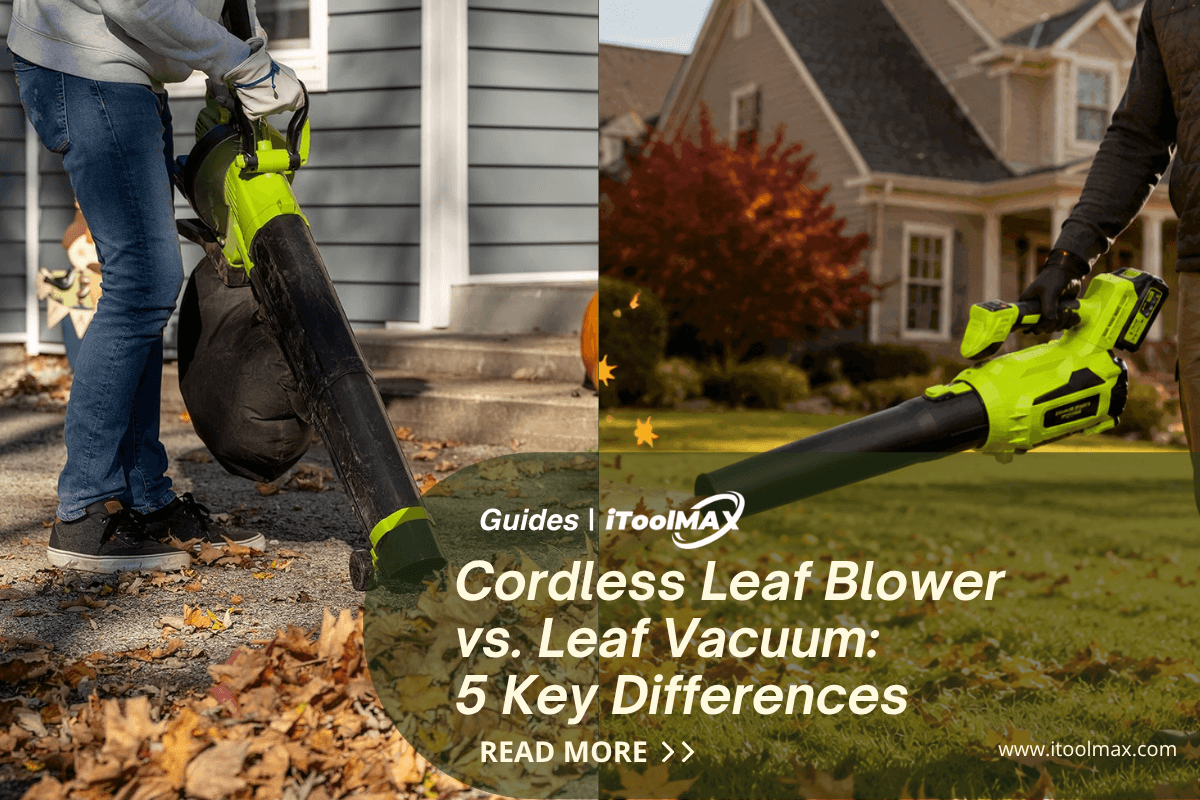
Choosing between a cordless leaf blower and a leaf vacuum can be confusing. Both are designed to make yard cleanup easier, but they address different needs.
I’m Carter Cathy from the iToolMax product team, and our users have also emailed us asking how to choose and where to buy these tools. First, a leaf blower uses airflow to blow away leaves and debris; while leaf vacuums use suction to collect fallen leaves, and some models can even shred them for easier disposal or composting.
After examining the design principles of these tools, their most suitable use cases, and their performance in handling common fall cleanup tasks, here’s the simplest rule of thumb: Choose a leaf blower when speed and covering large areas are most important; choose a leaf vacuum when collecting and shredding leaves is the top priority.
Quick Answer: Leaf Blower or Leaf Vacuum?
| Feature | Cordless Lear Blower | Leaf Vacuum |
| Main function | Moves leaves and debris | Collects leaves and debris |
| Working method | Forced airflow | Suction |
| Large-area cleanup | Excellent | Good |
| Leaf collection | Requires a separate step | Built in |
| Mulching | No | Some models can |
| Tight areas | Excellent | Excellent |
| Wet leaves | Depends on airflow and conditions | No |
| Light snow | Some models can handle light, dry snow | No |
| Best for | Fast cleanup | Collection and mulching |
Greenworks similarly describes blowers as faster for large areas, while vacuums are better suited to precision work and collecting debris in a bag.
What Is a Cordless Leaf Blower?

A cordless leaf blower uses a battery-powered motor and fan to create a high-speed stream of air. Instead of picking leaves up, the airflow pushes them across the ground so you can gather them into a manageable pile. This makes a battery-powered leaf blower particularly useful when you have a lot of ground to cover.
Pros
- Fast large-area cleanup—Move leaves across lawns, driveways, sidewalks, and patios quickly.
- Easy to maneuver—No extension cord limits where you can work.
- Versatile— In addition to leaves, a blower can move grass clippings, dust, pine needles, and other lightweight outdoor debris.
- Useful beyond fall — Depending on the model, blowers can also be used for patio cleanup, garage cleanup, and light, dry snow.
Cons
- It merely blows debris away rather than removing it.
- Not all models can handle wet leaves or tightly packed leaf piles.
What Is a Cordless Leaf Vacuum?

A Cordless leaf vacuum works in the opposite direction. Instead of pushing debris away, it creates suction that pulls leaves through a nozzle or tube and into a collection bag. Many leaf vacuum mulchers add an impeller or shredding system that breaks leaves into smaller pieces before they reach the collection bag. That can reduce the volume of material you need to carry away.
Pros
- Collect fallen leaves directly
- Reduce the need for manual bagging
- Many models can shred fallen leaves into mulch
- Making them easier to compost or dispose of
Cons
- Usually slower than blowing
- Wet leaves are difficult to suck up or may cause clogs
- Other debris may increase the risk of clogs
Leaf Blower vs. Leaf Vacuum: 5 Key Differences
① How They Work
Think of it this way:
- Leaf blowers = move debris.
- Leaf vacuums = collect debris.
Leaf blowers use a forced airflow to move debris. You can direct the airflow toward a collection area, the curb, a compost pile, or other locations.
Leaf vacuums, on the other hand, use suction to collect debris. Leaves are drawn through the vacuum system into a collection bag. Some machines even shred the leaves into mulch during this process.
② Cleanup Speed: Which Clears Leaves Faster?
Conclusion: A leaf blower cleans up faster.
For open, large areas, the airflow gives leaf blowers a significant practical advantage.When using a leaf blower, you can operate it while standing upright and clear large areas of fallen leaves in a single continuous pass. You can gradually push the leaves toward a designated spot without having to stop to empty the leaf collection bag.
Leaf vacuums, on the other hand, operate differently. You need to aim the intake directly at the leaves and collect them as you go. This makes leaf vacuums very useful when you need to end up with a bag of collected leaves, but if you’re starting with a large lawn covered in leaves, the job may take longer.
Buying Tip: Don’t judge a leaf blower solely by the CFM (cubic feet per minute) or MPH (miles per hour) ratings listed in advertisements. Nozzle design and airflow delivery methods also affect the tool’s actual efficiency in clearing debris.
③ Ease of Use, Handling & Noise
| Leaf blowers | Leaf vacuums | |
| Ease of Use | 4/5(Adjust the speed or replace the nozzle) | 3/5 (Installing filter bags & preventing clogging) |
| Noise (Cordless) | 4.5/5 | 4.5/5 |
| Ease of Use for Beginners | 5/5 | 4/5 |
We conducted our testing based on three criteria: the leaf blower came out on top. It’s easier to use, and based on its overall performance, it’s suitable for a wider range of applications.
④ Wet Leaves & Light Snow: What Can Each Tool Handle?
Wet Leaves:
The tool that can handle this: a leaf blower
Wet leaves are heavier and tend to stick together, making them harder to clear. A powerful leaf blower is still useful, but it will work more slowly than when dealing with dry leaves.
Leaf vacuums face different challenges. Wet leaves may be harder to draw into the intake, which can cause clogs or reduce collection efficiency.
Some users have asked about 2-in-1 blow vacuum models for cleaning wet leaves. These also work best with dry leaves and can still struggle a bit with wet leaves
Light Snow:
The tool that can handle this: a leaf blower
Leaf blowers also have a practical use in winter: clearing light, dry snow from suitable surfaces. This is different from using a snowblower. Handheld leaf blowers are better suited as emergency tools for handling light snow, especially before the snow has become compacted or heavy. Leaf blowers are not tools specifically designed for snow removal.
⑤ Best Use Cases: Where Does Each Tool Work Best?
| Cleanup Job | Better Choice | Why |
| Large lawn covered in leaves | Leaf blower | Fast debris movement |
| Driveway | Leaf blower | Quickly clears broad surfaces |
| Sidewalk | Leaf blower | Easy directional control |
| Patio | Leaf blower | Fast and convenient |
| Large leaf piles | Leaf blower | Quickly gathers leaves |
| Flower beds | Leaf blower or vacuum | Depends on whether you want to move or collect leaves |
| Tight corners | Leaf blower or vacuum | Choose based on whether you need movement or collection |
| Leaf collection | Leaf blower | Directly collects debris |
| Leaf mulching | Leaf vacuum mulcher | Shreds leaves during collection |
| Light, dry snow | Leaf blower | Useful seasonal application |
How to Choose the Right Tool for Your Yard
Choose a Leaf Blower If...
- Have a medium-sized or large yard
- Want to finish cleanup quickly
- Need to regularly clean driveways and sidewalks
- Need to clear large amounts of fallen leaves
- Also need to clear grass clippings, dust, or other lightweight debris
- Want a tool that can handle a variety of seasonal cleanup tasks
Choose a Leaf Vacuum If...
- Prefer to collect fallen leaves rather than simply remove them
- Prefer to bag and dispose of them
- Prefer to shred fallen leaves into mulch
- Frequently clean up flower beds or small areas
- Prefer to reduce the volume of collected leaves before disposal or composting
If you’d like to learn more about Cordless Leaf Blower or leaf vacuum, visit or contact the iToolMax store, where you can enjoy a first-order discount and free shipping.
3 Yard Tools to Pair With Your Leaf Blower
- 8000RPM Bladeless Electric Leaf Mulcher & Shredder: Equipped with a 50-liter collection bag, it has a nominal reduction ratio of 17:1. Its adjustable control system is specifically designed to handle a variety of shredding conditions, including both dry and wet leaves. It can reduce the volume of material prior to processing or composting.
- 6-In-1 Cordless Hedge, Trimmer: Fall is also the ideal time to prune problem branches and prepare your yard for winter. With an adjustable telescoping pole that extends from 10.8 to 14 feet, you can easily trim high branches without having to climb, getting everything ready for fall and the upcoming holidays.
- 3 In 1 Cordless Grass Trimmer, Weed Eater and Edger: Before using a leaf blower to clean up your yard, be sure to trim any overgrown grass and weeds along the edges. The 3-in-1 Cordless Lawn Mower, Weed Trimmer, and Edger combines trimming, mowing, and edging functions into one tool. Its adjustable-length design is engineered to make it easier for you to handle various lawn care tasks.
FAQ
Is it better to get a leaf blower or vacuum?
Neither of these tools is definitively better than the other. For many homeowners, a leaf blower is the more versatile choice because it can clear a wider variety of lightweight outdoor debris.
Can leaf blowers vacuum leaves?
A standard leaf blower cannot vacuum up fallen leaves. A combination blower-vacuum can do this, but it must be equipped with a dedicated intake port, a suction system, and a leaf collection bag.
Can a leaf blower remove wet leaves?
Yes, but wet leaves are harder to clear than dry ones because they're heavier, so it's recommended to choose a leaf blower with more power.
Most users read:
- Best Fall Yard Cleanup Tools for Easier Autumn Yard Work
- 9 Best Outdoor Halloween Decorations for a Spooky Yard
- Why Is My Lawn Mower Not Cutting Evenly?
Partager:
Why Is My Lawn Mower Not Cutting Evenly?