
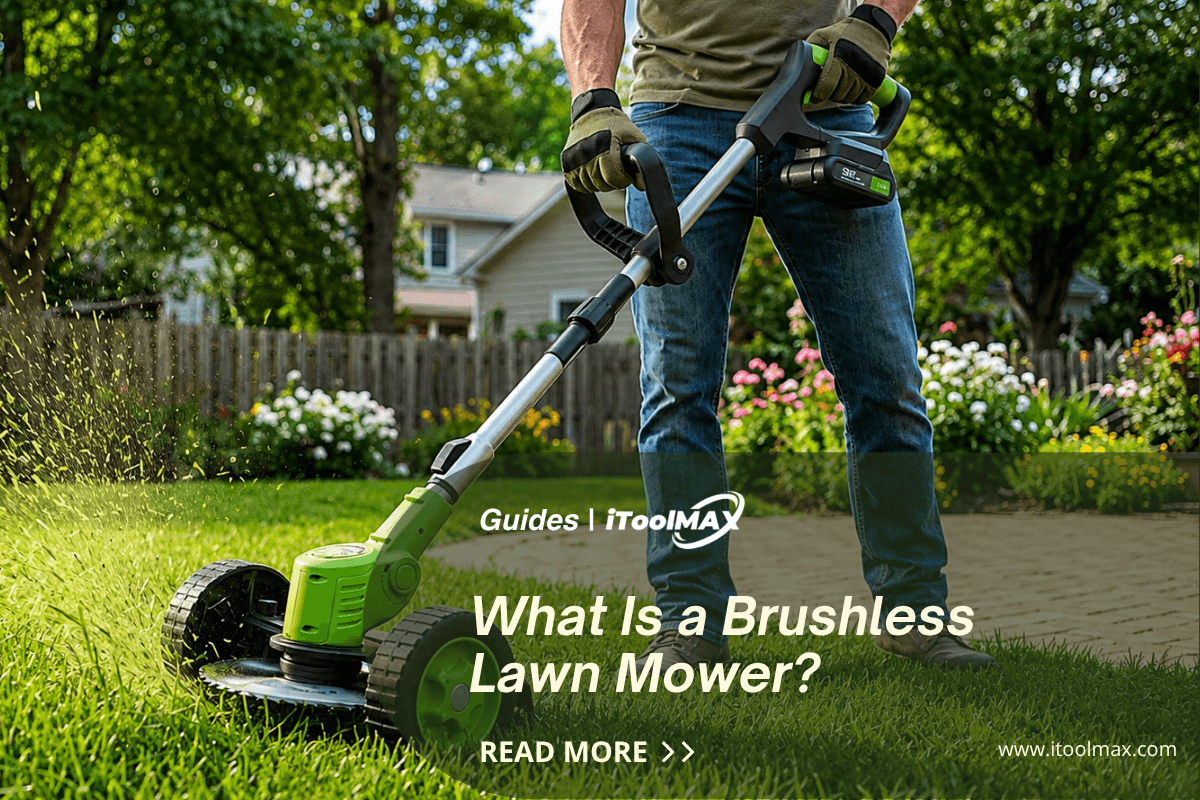
Dus, wat is een borstelloze grasmaaier? Het is een elektrische maaier gebouwd rond een borstelloze motor — een motor die magneten en een elektronische snelheidsregelaar (ESC) gebruikt om het mes te laten draaien, in plaats van de fysieke koolborstels waarop een traditionele elektrische motor vertrouwt. Geen fysieke borstels betekent minder wrijving, minder warmte en minder slijtage, wat resulteert in een stillere maaier, een langere levensduur van de motor en vermogen dat zich automatisch aanpast aan de dikte van het gras.
Door dit artikel te lezen, leer je:
- Wat een borstelloze grasmaaier is
- Hoe het werkt
- De voor- en nadelen
- Hoe het verschilt van een grasmaaier met borstels
- Of het geschikt voor je is
- Factoren om te overwegen bij de aankoop
Wat is precies een borstelloze grasmaaier?
Een borstelloze grasmaaier is een type elektrische grasmaaier — of die nu op netstroom of batterij werkt — en het belangrijkste onderscheidende kenmerk is dat er geen fysiek contact is tussen de bewegende en stilstaande onderdelen wanneer de motor draait.
In een standaard “met borstel” elektrische motor wrijven kleine koolborstels fysiek tegen een roterende commutator om elektriciteit te geleiden; dit basale ontwerp wordt al meer dan een eeuw gebruikt in elektrische motoren. Deze wrijving is precies waar de term “met borstel” vandaan komt, en het is ook de bron van de meeste slijtage en het geluid in motoren met borstels.
Borstelloze motoren elimineren dit contact volledig. In plaats daarvan genereert een printplaat en een elektronische snelheidsregelaar een roterend magnetisch veld dat direct de rotor aandrijft. Omdat er geen fysiek contact is, is er geen slijtage door wrijving zoals bij motoren met borstels, wat resulteert in minder warmteontwikkeling en minder geluid.
Hoe een borstelloze grasmaaier eigenlijk werkt
Haal de marketingtaal weg en het mechanisme is eenvoudig:
- De ESC meet hoeveel weerstand het mes ondervindt (dun gras versus dik, vochtig gras).
- Het past de elektrische stroom die naar de spoelen van de motor wordt gestuurd in realtime aan.
- Permanente magneten gemonteerd op de rotor reageren op die wisselende stroom en laten het mes draaien.
- Omdat er geen contact is tussen borstel en commutator, zijn de enige echte slijtagepunten de lagers — die veel langer meegaan dan koolborstels.
Die derde stap is het belangrijkst voor de dagelijkse prestaties: het is waarom een borstelloze maaier moeiteloos door een dicht, overwoekerd stuk kan gaan zonder vast te lopen zoals een motor met borstels vaak doet, zonder dat je een enkele instelling hoeft aan te passen.
Belangrijkste voordelen van een borstelloze grasmaaier
- Langere levensduur van de motor. Omdat er geen borstels zijn die slijten, is de motor zelf zelden het eerste onderdeel dat faalt.
- Geschikt voor alle soorten gazons. De controller detecteert dichter gras en verhoogt automatisch het koppel.
- Hogere batterij-efficiëntie. Borstelloze grasmaaiers dekken meestal een aanzienlijk groter oppervlak per lading.
- Gemakkelijk onderhoud. Geen olie verversen of bougies vervangen nodig, zoals bij benzinemaaier.
- Stillere werking. Minder interne wrijving resulteert in aanzienlijk lagere geluidsniveaus.
- Verbeterde warmteafvoer, wat leidt tot lagere bedrijfstemperaturen.
- Lagere onderhoudskosten. Borstelloze motoren verminderen de frequentie van vervangingen en reparaties.
- Superieure gebruikerservaring en gemak. Lichter en gemakkelijker te manoeuvreren.
Het echte probleem
- Hogere aanvangskosten. De magneten en elektronische controller voegen echte productiekosten toe, die bij de kassa worden doorberekend. Je kunt ook overwegen een 4-in-1 elektrische onkruidverdelger te nemen; zo kun je maaien, afboorden en struikgewas knippen met één apparaat voor je hele tuin.
- Als er problemen optreden, kunnen reparaties ingewikkeld zijn. Dit is precies wat wij hebben meegemaakt. Een van onze borstelloze batterij grasmaaiers kreeg halverwege het seizoen een controllerstoring—niet door slijtage, maar door een storing in de elektronische componenten.
Borstelmotor vs. borstelloze grasmaaiers: zij-aan-zij vergelijking
| Kenmerk | Borstelmotor | Borstelloze motor |
|---|---|---|
| Hoe vermogen de rotor bereikt | Fysieke koolborstels maken contact met een commutator | Elektronische snelheidsregelaar creëert een roterend magnetisch veld |
| Levensduur | Korter — borstels slijten en moeten worden vervangen | Langer — geen contactonderdelen die slijten |
| Onderhoud | Af en toe borstels vervangen | In wezen geen bij normaal gebruik |
| Geluidsniveau | Luidruchtiger, door wrijving | Merkbaar stiller |
| Vermogen onder belasting | Vast; kan vastlopen in dik gras | Past het koppel automatisch aan op de grasdichtheid |
| Batterij-efficiëntie | Gebruikt ongeveer hetzelfde vermogen ongeacht de belasting | Trekt alleen wat nodig is, verlengt de gebruiksduur |
| Aanvangskosten | Lager | Hoger, soms met $50–$150 afhankelijk van het model |
| Repareerbaarheid | Eenvoudig, vaak doe-het-zelf | Meestal professionele reparatie nodig als de controller faalt |
Is een borstelloze grasmaaier de moeite waard? Stap voor stap
- Schat je werkelijke maaibelasting. Een kleine, eenvoudige tuin die wekelijks wordt gemaaid, zal de motor waarschijnlijk nooit zo belasten dat je het verschil merkt.
- Controleer hoe vaak je dik of overwoekerd gras maait. Als je het gazon regelmatig uit het oog verliest, is adaptief koppel de meest nuttige borstelloze functie.
- Houd rekening met de batterijduurverwachtingen, vooral bij grotere percelen waar het echt vervelend is als de batterij halverwege het maaien leeg raakt.
- Bereken het risico op reparatie, niet alleen de besparing op onderhoud — een defect aan een borstelloze motor komt minder vaak voor maar is duurder dan bij een borstelmotor.
- Stem het af op hoe lang je van plan bent de maaier te gebruiken. Het voordeel in levensduur stapelt zich op over jaren; het betekent weinig als je toch elk seizoen een nieuwe maaier koopt.
Wie borstelloze grasmaaiers zou moeten gebruiken:
- Huishoudelijke gebruikers die regelmatig hun gazon moeten maaien
- Mensen die op zoek zijn naar weinig geluid en weinig onderhoud
- Gebruikers met kleine tot middelgrote gazons
- Vrouwen, senioren en huisvrouwen
- Mensen die geen benzinegrasmaaiers willen gebruiken
- Gebruikers die langere gebruiksduur en hogere efficiëntie zoeken
- Doe-het-zelf tuinliefhebbers
De beste borstelloze grasmaaier: 3-in-1 draadloze grastrimmer, onkruidverdelger en afboorder
Beoordeling: ⭐⭐⭐⭐(4,8/5) | Werkbreedte: 15 cm | Lichtgewicht: 1,48 kg | Gebruikstijd: tot 60 minuten | Huidige prijs: $129,99 (inclusief dubbele 2.0Ah batterij)

iToolMax 3-in-1 Draadloze Grastrimmer ($129,99) werkt op een 21V-batterijsysteem met twee meegeleverde batterijen, een opgegeven 1800W motor en een maaisnelheid van 18.000 RPM, met een in hoogte verstelbare steel van ongeveer 35 tot 47 inch. Hij gebruikt ook een borstelloze motor, wat overeenkomt met het lichte totale gewicht (ongeveer 1,48 kg) en de bewering van de fabrikant dat er minder slijtage optreedt na verloop van tijd. Hij wordt geleverd met roestvrijstalen messen voor maaiwerk, nylon messen voor lichtere trimwerkzaamheden en een cirkelzaagblad voor houtachtige groei.
Beste voor: kleine gazons, afboordingen en krappe plekken bij hekken of borders.
Vervangt niet: een volwaardige duw- of zelfrijdende maaier voor meer dan een kleine tuin.
→ Bekijk 3-in-1 Draadloze Grastrimmer
Eindresultaat
Hoewel borstelloze grasmaaiers een hogere prijs hebben, bieden ze een stillere, duurzamere motor en kunnen ze automatisch het vermogen aanpassen op basis van de dichtheid van het gras—voor de meeste routinematige maaiwerkzaamheden is deze afweging het zeker waard.
Als je nog steeds moeite hebt met het kiezen van een borstelloze elektrische grasmaaier, of als je niet zeker weet welk model het beste bij je past, laat dan gerust een reactie achter of neem contact met ons op (support@itoolmax.com). We bieden een korting op de eerste bestelling en gratis verzending.
De meeste gebruikers lezen:
Delen:
Hoe vaak moet je je gazon maaien?
9 Beste Tuingereedschap Organizers voor Kleine Ruimtes 2026: Slimme Opslagideeën